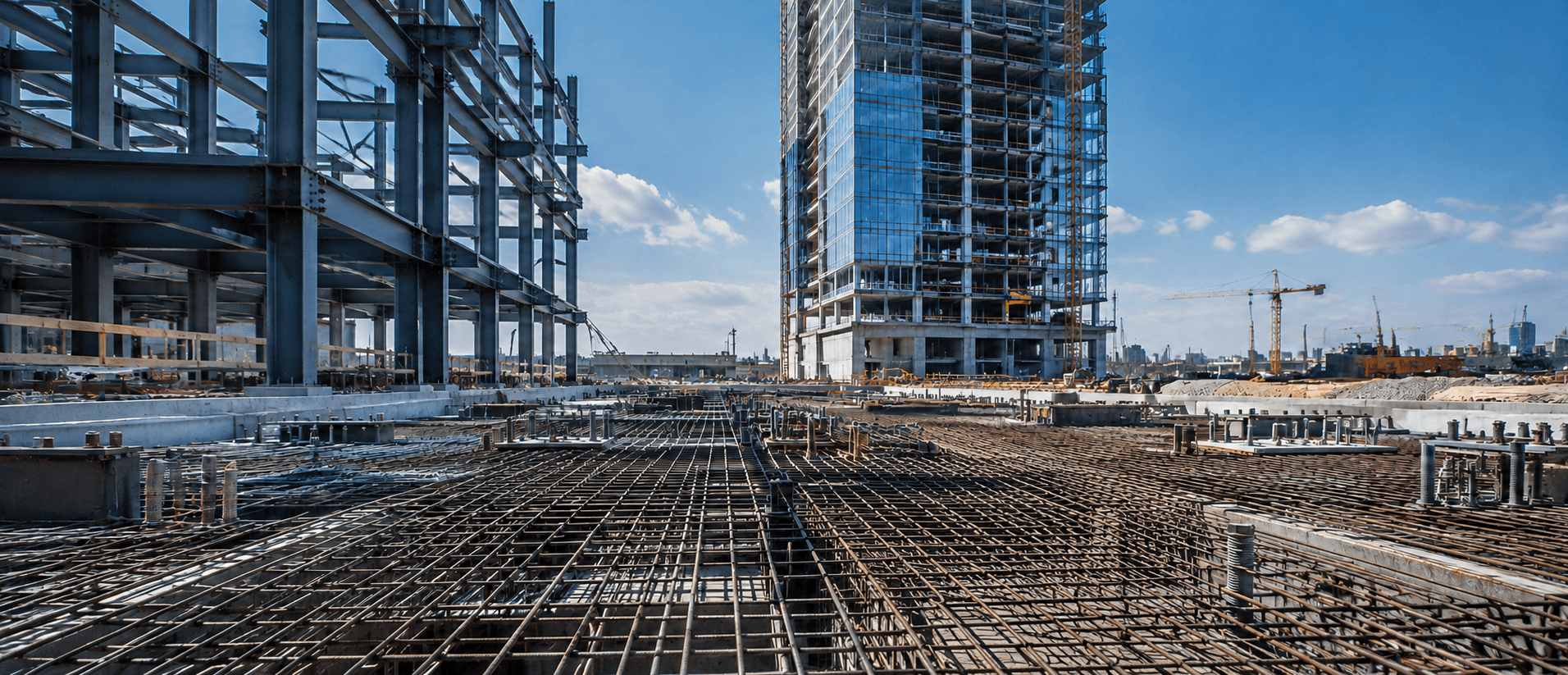
Tower foundations and high-rise structures are subjected to significant loads resulting from the weight of the structure and operational loads, in addition to lateral forces caused by wind and earthquakes. Therefore, choosing the right steel for tower foundations is not limited to determining a specific size or thickness; rather, it is related to the entire structural system, the nature of the loads, the type of foundations, the properties of the steel and concrete, and the requirements of the approved design code.
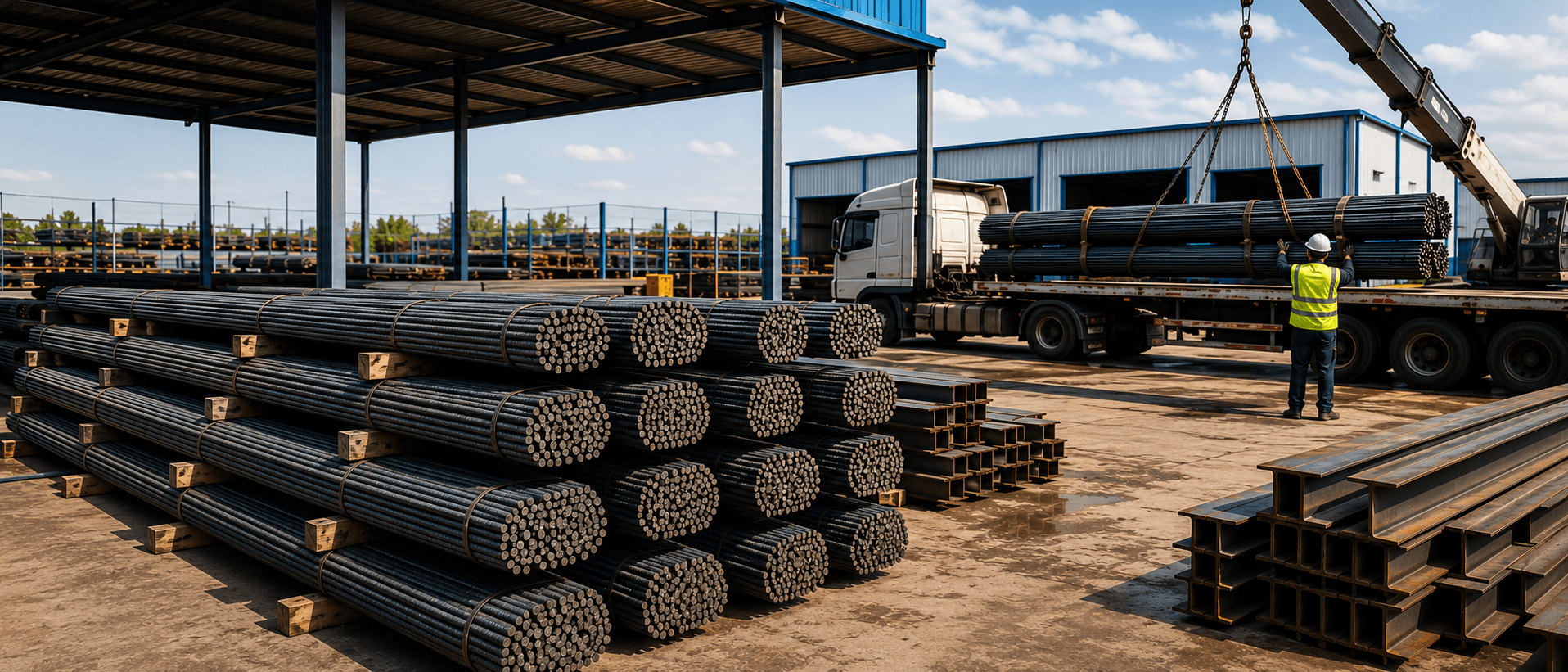
In large projects, foundation works may involve more than one type of steel product, ranging from reinforcement for concrete foundations to steel plates, structural sections, and embedded steel elements used for connections, load transfer, and structural anchoring.
What Is the Importance of Choosing the Right Steel for Tower Foundations?
Foundations are the structural elements that transfer the loads of a tower or building to the ground. As the height and size of the building increase, controlling the transfer of forces between the columns or structural framework and the foundations becomes increasingly important.
In concrete foundations, reinforcing steel works together with concrete to resist tensile forces and bending moments and to control cracking, while other steel products for high-rise structures may be used in connection and anchoring details, as well as in steel and composite structural systems.
The importance of Shear Studs also becomes evident in certain structural details that require effective bonding between steel elements and concrete. They help transfer shear forces, reduce slippage between the two materials, and achieve composite action between them, particularly when used with plates or embedded steel elements, as specified by the structural design.
Therefore, each steel product should be selected according to its actual function in the project and the requirements of the structural drawings and approved code, rather than based solely on price, thickness, or market availability.

What Types of Steel May Be Used in Tower Foundation Works?
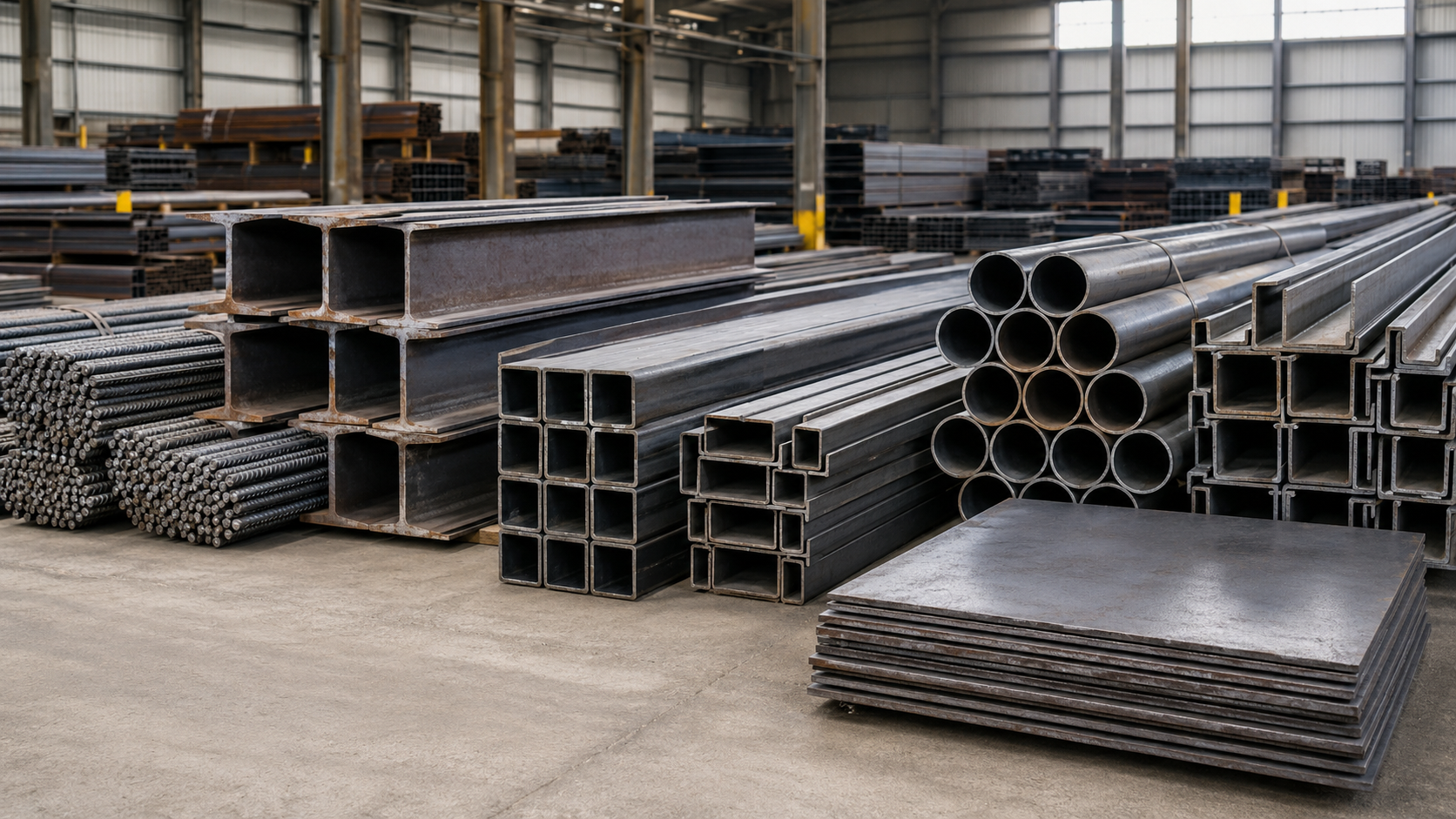
The required product varies depending on the structural system and project details. Among the steel products used in the construction sector are:
I-Beam Steel Beams
I-Beam sections are used in steel structures and frameworks and may be connected to foundation systems through base plates, anchoring plates, and connections designed to transfer loads to the concrete.
The selection of an I-Beam section depends on the structural analysis, section strength, member length, loading method, and connection details.
Steel Plates
Steel plates are used in various structural details, such as Base Plates, reinforcement plates, connections, and embedded steel elements.
The plate thickness is not determined arbitrarily; rather, the thickness, plate dimensions, and the number and locations of anchors are related to the forces that must be transferred according to the design.
Angles, Tubes, and Steel Pipes
Steel angles, tubes, and pipes may be used in support elements, secondary structures, frames, and other metal works associated with the project.
Their suitability varies depending on the loading conditions, section type, connection method, corrosion protection, and structural design requirements.
Sheet Metal Products
The products available from Smart Skill include black steel sheets and coils, galvanized sheets, checkered sheets, and coated sheets.
These products are used in various structural and fabrication applications; however, they are not a direct substitute for foundation reinforcement bars. The product should always be selected according to its specific function in the drawings and specifications.
Key Factors Affecting the Selection of Foundation Reinforcement Steel
Vertical and Lateral Loads
Towers are subjected to significant vertical loads, but the design does not depend on these loads alone. Wind and earthquakes can generate horizontal forces and moments that are transferred from the structure to the foundations.
Therefore, the distribution of reinforcement and steel elements must be capable of handling the load cases specified in the structural analysis.
Foundation Dimensions and Depth
The type of foundation, whether isolated footings, combined footings, a raft foundation, or a pile-based system, directly affects the required steel details.
The design determines the locations, directions, quantities, and anchoring details of the steel in accordance with how forces are transferred within the foundation.
Concrete Strength and Integration with Steel
Concrete and steel work together as a single system; therefore, the efficiency of the foundation does not depend solely on the quality of the steel.
Concrete strength, concrete cover, bond with the steel, anchorage and connection locations, as well as the ability to properly cast concrete around reinforcement grids and steel elements, must all be taken into consideration.
How to Choose Steel for Tower Foundations?
The correct selection begins with the project drawings and technical specifications. Among the most important points that should be reviewed are:
- Identify the required steel product and its structural function.
- Verify the steel grade and its mechanical properties according to the design.
- Comply with the diameters, thicknesses, and dimensions specified in the drawings.
- Verify the required yield and tensile strength.
- Review weldability when the details include welded connections.
- Comply with anchorage lengths, lap lengths, and connection details according to the design and applicable code.
- Verify quality and conformity certificates and the source of the material.
- Consider site conditions related to moisture, salts, and corrosion.
- Do not substitute one type or size for another without engineering approval.
Therefore, selecting steel for tower foundations is both an engineering and procurement decision, not merely a comparison between product diameters or thicknesses.
The Difference Between Main and Secondary Reinforcement in Foundations
Main reinforcement is the steel primarily responsible for resisting tensile forces and bending moments in critical areas of the foundation. Its direction, quantity, and location are determined by the structural design.
Secondary or distribution reinforcement helps distribute stresses, control cracking, and maintain the proper arrangement of the reinforcement grid.
Despite being referred to as secondary reinforcement, it is not an optional element; compliance with all reinforcement details shown in the drawings is essential to achieve the required structural behavior.
Steel Specifications and Quality for High-Rise Structures
When supplying steel for high-rise structures, a range of properties must be considered, not just the shape or dimensions.
These properties include yield and tensile strength, dimensional accuracy, surface quality, fabrication and welding capabilities when required, as well as the product’s compliance with the technical specifications approved for the project.
The required material certificates and test reports should also be available to verify the steel’s compliance before it is used in structural works.
Environmental Conditions and Their Impact on Steel Selection
Foundations and steel elements may be exposed to moisture, groundwater, or salts, which can increase the risk of corrosion if the necessary protection requirements are not taken into account.
The project may require the use of specific steel grades, protection systems, or coatings depending on the level of exposure and the surrounding environment. These requirements are determined by the designer and the project’s technical specifications.
Common Mistakes in Selecting and Installing Foundation Reinforcement Steel
Some of the most important mistakes that should be avoided include:
- Using steel materials without clear certificates of conformity.
- Changing sizes or thicknesses from those specified in the drawings.
- Substituting one steel grade for another without the designer’s approval.
- Improperly storing steel and exposing it to contaminants or unsuitable site conditions.
- Installing laps and connections in unapproved locations.
- Welding without verifying the material’s weldability and the appropriate welding method.
- Overcrowding reinforcement in a way that prevents concrete from reaching all parts of the foundation.
- Using a type of steel product for a structural function for which it was not designed.
The Importance of Choosing a Reliable Structural Steel Supplier
In tower and large-scale construction projects, the supplier’s role is not limited to providing the required quantity. The supplier must also be capable of supplying products according to the required specifications and dimensions, along with quality documentation, while meeting the project’s needs within the scheduled timeframe.
Smart Skill provides a range of structural steel products, including I-Beams, steel plates, angles, tubes and pipes, as well as black, galvanized, coated, and checkered steel sheets and coils, serving a variety of construction and industrial project requirements according to each project’s specifications.
Engineering Summary for Ensuring Safe Foundations
Selecting steel for tower foundations should begin with the structural design and end with procurement and execution that comply with the specifications. The type, grade, size, thickness, and method of anchoring or connecting the steel are all interrelated factors that affect the performance of the structure.
It is also important to distinguish between foundation reinforcement used within concrete and the steel plates, sections, and other steel elements used in connections, structural frameworks, and metal works associated with the foundation.
Therefore, the best product is not necessarily the largest or heaviest, but rather the one that complies with the structural drawings, specifications, and approved code, and is supplied and installed under the supervision of the responsible engineering team.